
In the first part I lined up the physical problems of data centers in space: debris, radiation and above all heat dissipation, which can only be solved by putting more surface area into orbit and therefore more material. Here I start from there: how much it costs to send that material up, and what happens when it breaks.
The Money#
Until not long ago the biggest problem with sending “stuff” into space was that it cost an enormous amount, to the point that almost only state bodies could afford the investment. The Shuttle, for example, cost more than $50,000 per kg (https://ntrs.nasa.gov/citations/20200001093, although, like everything, it’s complicated and highly variable).
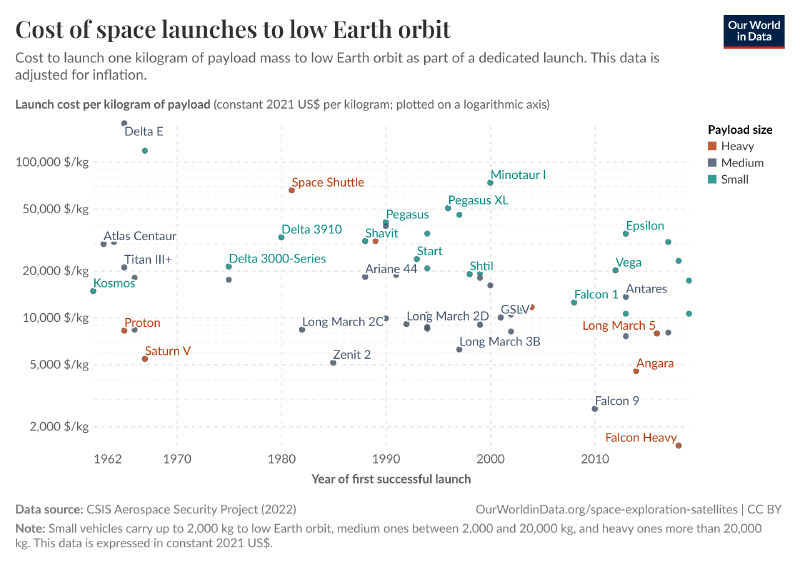
Only the arrival of Elon Musk and his Falcon 9 and Falcon Heavy made it possible to truly and drastically lower the cost of launching into orbit, even below $2,000/kg. This is an essential point: a large part of the commercial orbital things we are seeing nowadays are consequences of that hugely important drop in cost, which allows many more companies to send things into space. Cubesats, which thanks to their small size have been used for years for small experiments and also a bit of outreach, have become extremely widespread precisely because with relatively little money it is possible to send something into space and run a series of small, limited experiments without needing an entire NASA-style satellite (or time on the ISS, which I believe is also pretty expensive).
But we were talking about data centers in space. Well, if we put together the physical problems I pointed out in the first part, any solution that doesn’t rely on technologies not yet discovered or on cooling mechanisms exploiting physical principles still unknown necessarily implies sending a lot of material into orbit. At a minimum the solar panels (in theory terrestrial ones aren’t suitable, in space you need special ones: https://www.nasa.gov/smallsat-institute/sst-soa/power-subsystems/ - SpaceX however uses terrestrial panels, accepting a shorter lifetime), but also the radiators and the server, obviously. If every launch and every component costs a great deal, the business isn’t economically sustainable. Someone has also done the maths: it has to cost less than $200/kg to break even with the cost of energy on the ground (https://arxiv.org/pdf/2511.19468 - a paper by Google; https://medium.com/@drjohnmillar/the-surprising-economics-of-orbital-data-centers-and-the-true-solution-9555aa3d3d24 an analysis that seems to me to line up the numbers fairly well) and probably less than $150/kg for it to be worthwhile.
Nobody is hitting these numbers today.
There is a but, indeed several, all of them however looking to the medium-term future (5 years? 10 years? thereabouts):
- The sharp drop in costs is essentially driven by the reusability of rockets. The commercial monopoly on this technology currently belongs to SpaceX, which in fact with its future Starship, if and when it is ready and reliable, could theoretically reach a cost between $100/kg and $200/kg, so in the ballpark. However, on 10 July 2026 China managed to recover a rocket that would at this point be theoretically reusable, the Long March 10B (https://edition.cnn.com/2026/07/10/china/china-reusable-rockets-test-breakthrough-intl-hnk), with a completely different method. This means, in my opinion, that there will be competition relatively soon, and consequently it is possible and far more likely that the cost will drop a great deal, and soon, especially considering the geopolitical rivalry between the two blocs that currently have (or will very shortly have) reusable rockets. This is a strong push, looking ahead, in the direction of sending data centers into space.
- On the ground there are several lines of research that aim in various ways to make today’s computing more energy-efficient, and these instead push in the opposite direction. I’ll mention just:
- on the one hand the race for AI models that are ever better but also more efficient in terms of power consumption; China seems to be ahead, amid endless discussion and controversy, but at the same time energy consumption is still expected to grow at an incredible rate, probably driven by photo and video generation, which will keep expanding.
- on the other hand the evolution of cooling systems, for example with diamond heat sinks which from the first tests seem able to improve both computing power (up to +15% at high temperatures, mainly due to thermal throttling, that is the limiting of the use of that CPU/GPU because it is too hot and risks being damaged) and the power consumption due to the cooling systems, since data centers could at that point operate at 50°C instead of the traditional 24-29°C. I’d love to see the consultants in suit and tie walking into a data center to do some work then. To dig deeper I refer you to these two articles: https://akashsystems.com/post/akash-systems-announces-worlds-first-diamond-cooled-ai-servers-with-amd-instinct-tm-mi350x-gpus-and-mitac-computing (the company’s official post), and https://www.datacenterdynamics.com/en/news/akash-systems-launches-amd-powered-diamond-cooled-ai-servers/, a more accessible article. The gist is: since the energy is transferred more rapidly, CPUs and GPUs also cool down more rapidly and so the air conditioners can work less hard. The alternative is that it’s possible to put in more servers and more racks with the same air conditioners: either way, the computing power per watt of cooling increases. Even more concisely: more servers, less power. Interesting, however, that Akash Systems in any case also lists space among the industries that could benefit from its products (https://akashsystems.com/industries/space).
Time#
Time is money, right? As I said before, the drop in costs depends on the possibility of reusing rockets, but this kind of rocket lowers the cost per kg only if you can actually reuse it, and the launch cadence doesn’t depend only on the rockets.
The race to increase flights in order to put more material into orbit faster has a de facto ceiling and a very strong bureaucratic slowdown:
- the de facto ceiling is the extremely limited number of launch sites today: depending on what counts as a launch site (does a specialised airport that sends up an aircraft which releases a rocket count or not?), today we’re talking about 30 or 40 launch sites, depending on what is counted as a site, and moreover not all of them usable by everyone (North Korea and Iran have one site each under sanctions, China and Russia don’t use European and American sites and vice versa as a rule). Putting all the necessary material into orbit requires a great many launches, which require a great many rockets, which require a great many launch sites.
- To be fair, several are on the way: SpaceX for example has announced one in Louisiana, whose construction will start in 2027 (https://www.spacex.com/sites/starbase-la), and in China they use a kind of barge or ship adapted ad hoc that lets rockets launch from the sea (https://en.wikipedia.org/wiki/Gravity-1). I believe however that reaching the level of launches needed to send a data center into orbit will still take a long time, years probably.
- even if not directly linked to money, the bureaucratic ceiling is instead set by the approvals of launches, launchers, launch sites, satellites. However fast and efficient a bureaucracy may be (and in all honesty I have yet to see a fast and efficient bureaucracy), it exists and inevitably slows things down. In two well-known cases, in the United States, the slowness has been exasperating: the FAA, which authorises launches, with licensing times (the Part 450 regulation) that the industry denounces as taking years (https://spacenews.com/?p=505683); and the FCC, which authorises satellites, which in July 2026 passed an ad hoc reform (Part 100 - https://www.hklaw.com/en/insights/publications/2026/07/ground-control-to-major-reform-fcc-adopts-landmark-overhaul-of-space) to try to unblock the sector.
Maintenance#
It’s a point that is somewhat less discussed but has a very strong impact on everything else. It rests on an essential axiom of engineering: EVERYTHING BREAKS SOONER OR LATER. And if something breaks, it has to be repaired or it has to keep working.
And it can break spectacularly! Explosion of Isar’s first Spectrum rocket lifting off from the Norwegian base at Andøya. To be fair, the folks at Isar recently managed to complete their first orbital flight.
We’re talking about space. Sending people to repair an instrument has been done (see Hubble), but the technology used to do it no longer exists (the Space Shuttle). And if something breaks? What do you do?
The possible solutions are 3 (well, two and a half, as we’ll see). None of them comes even remotely close to the level of efficiency on the ground (a technician goes in, pulls out a server or a disk and swaps it), but it’s still interesting to look at these approaches:
- Ground testing, on-board redundancy, shorter lifetime. These are three pieces of the same thing: making the node work as long as possible and having an idea of how long it can last.
- In theory, running ground tests on the various components to verify their resistance to vacuum, vibrations etc. makes it possible to find satellites with problems in advance, improving the useful life in orbit. SpaceX already does something similar for the Starlink satellites (https://fdm-makers.com/en/halt-vs.-hass-testing-what-are-the-differences/ they aren’t specific to satellites, but a sort of standard), and in a mega-document it declares it will do so for data centers too (https://www.sec.gov/Archives/edgar/data/1181412/000162828026040364/spaceexplorationtechnologib.htm , page 10 of the “PROSPECTUS SUMMARY” section, bullet point: “We can leverage our terrestrial experience to build and operate compute clusters and AI workloads at scale” - I obviously haven’t read the whole document). I haven’t found figures on the effects of these tests, but in general it seems sensible to me, as far as I understand it.
- If parts can break on the satellite, one possible solution is to “send more of them”, so that even if some break there are others that keep going. Let’s be clear, we’re not talking only about computing power, but also radiators, solar panels, everything. How much more? The numbers vary a lot; this article by Forethought (https://www.forethought.org/research/will-we-really-put-data-centers-in-space) talks of 50% more solar panels to compensate for the degradation of commercial cells over 5 years. That’s no small amount: every extra thing sent into space is a cost, and here we’re talking about sending half as much again. Not only that: they estimate a 9% failure rate for chips, which over 5 years leads to almost 40% fewer usable chips.
- The linked article is by serious people (not like me, a
dilettantepassionate amateur) and so they have done a far more systematic analysis of the economic side too. Some assumptions are questionable (mapping the world and physics are complicated things) but overall it seems to me a nice, interesting piece of work.
- The linked article is by serious people (not like me, a
- Considering a shorter average lifetime for the single satellite, so that constant replacement becomes part of the economic cost of the operation. Here too the numbers diverge, between those who take as reference the 15 years of a data center on the ground and companies that estimate 5 because of the amount of radiation the chips can withstand and the lifetime of “commercial” solar panels in space, similarly to what Starlink does today. They all seem to me partial estimates, or made with a roll of the dice, so I cite the approach, which makes sense, but be particularly cautious with the numbers.
- Constellations. An approach that doesn’t rule out the others; on the contrary, it fits particularly well with the first to increase reliability. Essentially it’s a matter of imitating what SpaceX is doing with the Starlink constellation: not one big satellite, but many satellites close together and communicating with each other. Google with its “Project Suncatcher” is adopting this approach, and plausibly SpaceX will do the same, as will other companies in the sector. This approach has several advantages: it is intrinsically modular, a failure doesn’t compromise the constellation, it’s “enough” to send another satellite into space as a replacement; it allows a gradual upgrade of the infrastructure as the technology evolves, decommissioning (that is, usually, burning up in the atmosphere) the old-version satellite and sending up the new one. The big problem with this approach is the communication between the satellites/racks, which has to be very fast. This requires an ad hoc laser communication technology that already exists (thanks SpaceX) and relatively close distances.
- In-orbit maintenance. This is a field that is truly in its infancy. Performing in-orbit maintenance is possible, studies are being done and there is at least one company, Northrop Grumman (though there are probably more), that has already carried out servicing missions docking with satellites to extend their life (without robotic arms), and that in July 2026 launched a vehicle with purpose-built robotic arms and a sort of jetpack to give satellites extra propulsion, both operational from 2027 when they reach their destination orbits (see https://news.northropgrumman.com/launch/northrop-grummans-mission-robotic-vehicle-launches-ushering-in-a-new-era-of-in-space-servicing). However, at the moment there are no tools or methods precise and sophisticated enough to do fine-grained maintenance (swapping a single disk, replacing a GPU, things like that).
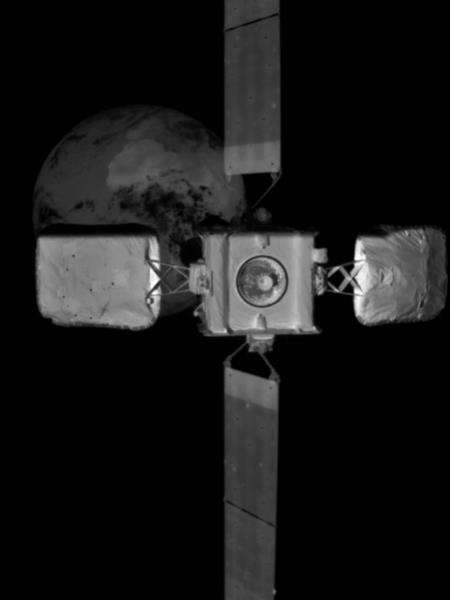
It’s also worth showing this YouTube video describing the first mission, taken from this article: https://spaceflightnow.com/2020/02/26/two-commercial-satellites-link-up-in-space-for-first-time/
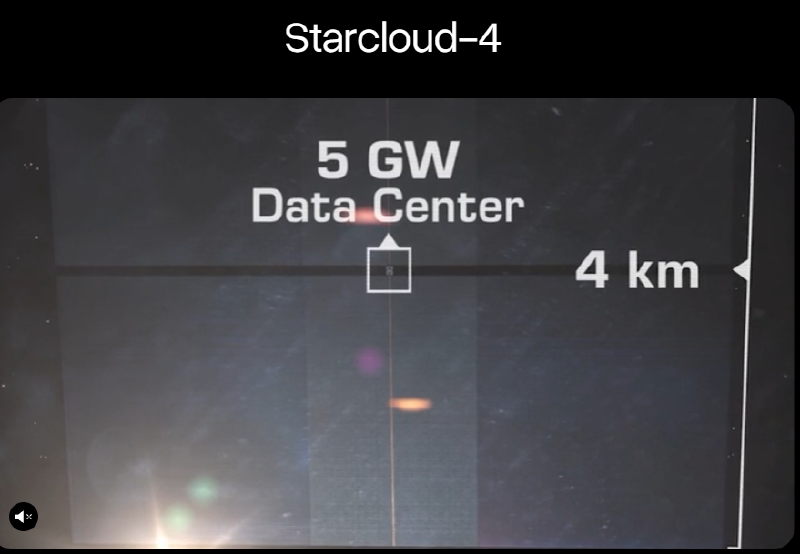
Personally, I’m of the opinion that it’s a matter of time and that the technology will mature; after all it is already possible to perform surgery remotely via robotic arms, but it’s best to be clear that nothing exists as of now. Starcloud (https://www.starcloud.com/), one of the companies talked about for space data centers, initially seemed to adopt a similar solution, infrastructure made of “self-contained” compute modules, so that the single module can be replaced, but the 2026 sources diverge on how far it too has shifted towards the constellation model.
This article was translated from the Italian original with the help of AI (Claude) and reviewed by the author.